

The bold text on a small notecard above a glib cartoon man named “Mr. Nice Guy” asks, “ARE YOU A GOOD PERSON?” To the right of the man, a purple silhouette of Mr. Nice Guy appears beside the words, “If you are a good person, the man will turn green.” Made of ink and cardstock, Mr. Nice Guy, of course, never changes color.
The result of this charade is irrelevant, because the card serves to remind its reader, in a cheeky yet disapproving tone, that they are not a good person — not the kind that will get into heaven, that is.
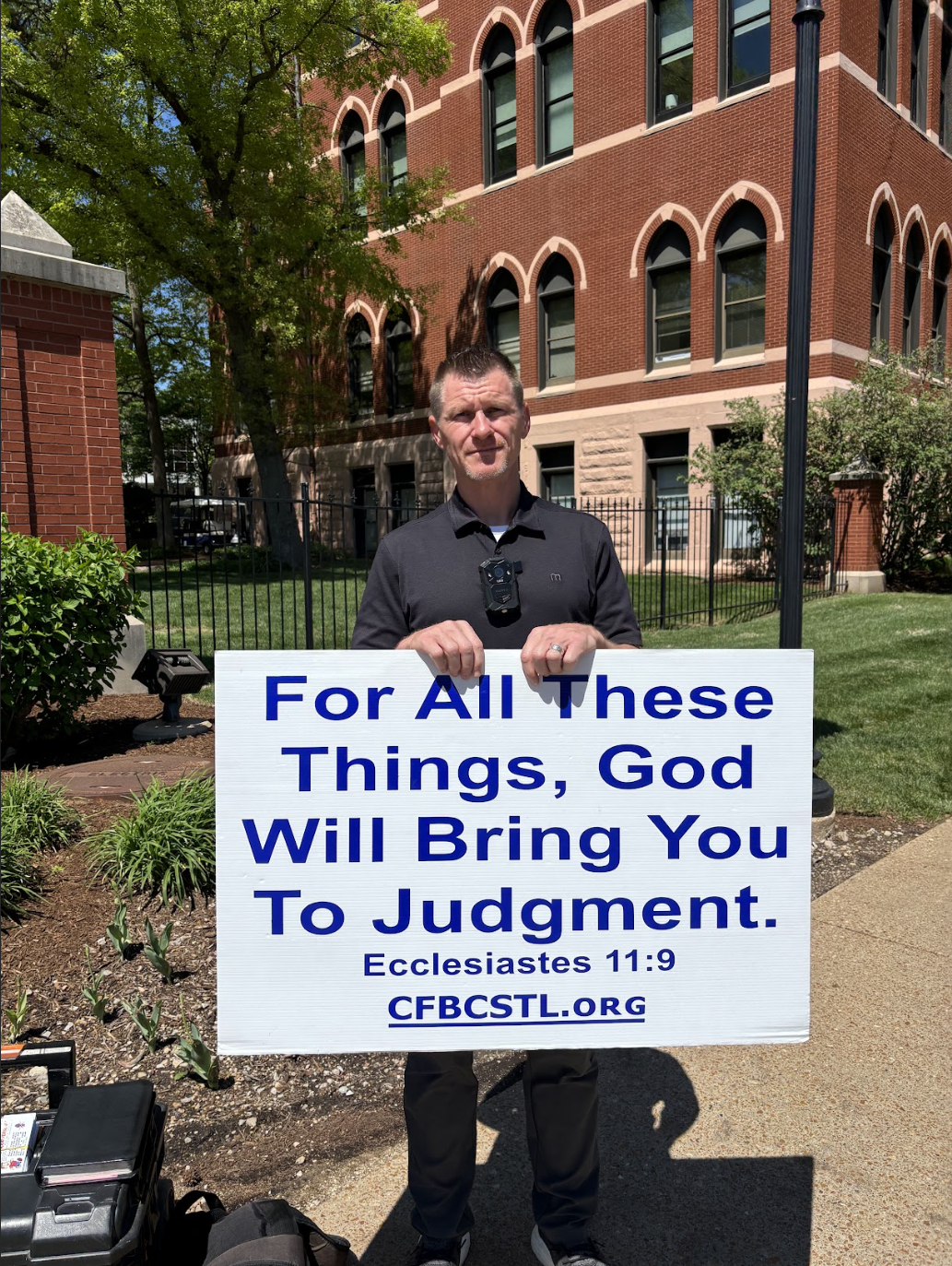
Geoff R. Kirkland, one of the street preachers frequently found at the crosswalks on Grand Avenue which unites Saint Louis University’s campus, hands out these cards to passing pedestrians each Thursday in the late morning. His mission to “accurately herald the saving gospel of Jesus Christ to the lost” is lost on many a passerby, as his public preaching often leads to controversy and frustration among SLU students.
Jackson Finler, a junior aeronautics major, said he sees the preachers as a negative presence on campus.
“They’re just using scare tactics,” Finler said. “It’s really disruptive, and they almost force you to take their pamphlets.”
He also said that their actions often put him in a “bad mood” when he encounters them as he crosses Grand Avenue.
“I’m not even, like, an atheist or a strong Christian at all. I’m very neutral to both sides, so I just don’t like how they do it,” Finler said.
Each day, hundreds of students pass through the crosswalks on Grand Avenue to get to their classes, dorms or meetings.
This doesn’t stop students, however, from noticing the handful of street preachers, who faithfully stand with megaphones, Bibles and various paper handouts every week.
This controversial method of preaching has the clear benefit of exposure — and that’s precisely the point.
Street-preaching, or open-air preaching, has a rich history. In fact, the first street preacher is often considered to be Jesus Christ himself through his Sermon on the Mount.
Protestants, however, adopted the method in the Protestant Reformation, a time rife with socio-religious conflict in which they were barred from many Catholic churches. Today, evangelical Christians, a subset within Protestantism that emphasizes personal conversion, still commonly preach in this public manner, and college campuses are often their primary audience.
One of the better-known street preachers spotted on college campuses nationwide is Cynthia D. Smock, or Sister Cindy, who went viral on social media for preaching slogans like “Be a hoe no mo.”
Although Sister Cindy uses spectacle and controversy to reach her audience of primarily college-aged young adults, the majority of street preachers are known for embracing apocalyptic, end-times messaging to quickly capture an audience’s attention.
SLU theology professor Brian Himes said that while he acknowledges the historical precedence of this kind of evangelism, “there is this tragedy to how they’re going about it … That they don’t seem to care how unsuccessful they are.”
Although Himes supports the preachers’ right to free speech, he feels as though their message is “naive.”
Certain students share Himes’ criticisms. Jackson Finler, a junior aeronautics major, said he sees the preachers as a negative presence on campus.
“They’re just using scare tactics,” Finler said. “It’s really disruptive, and they almost force you to take their pamphlets.”
He also said that their actions often put him in a “bad mood” when he encounters them as he crosses Grand Avenue.
“I’m not even, like, an atheist or a strong Christian at all. I’m very neutral to both sides, so I just don’t like how they do it,” Finler said.
Other students are more insistent that street preachers’ antics lead to genuine harm. A junior undergraduate student who requested to remain anonymous said that she has had “many situations where I’m walking with my friends who are wearing hijabs and they get confronted or targeted.”
She also thinks that the preachers’ tactics can be aggressive.
“I’ve had times where I’m walking across, and there’s a person holding pamphlets and they have almost pushed me into the street trying to give me a pamphlet,” she said.
She recalled moments from her freshman and sophomore years when the preachers condemned both people in the LGBTQIA+ community and Catholics.
While some students feel that the preachers’ messages are concerning, the preachers said that their appearances at SLU are just a part of their larger efforts to evangelize.
As a group, the street preachers said that they do not belong to one single organization but rather that they gather together to preach at certain locations around the city throughout the week.
Geoff, a leader at Christ Fellowship Bible Church, said that he is never outwardly hostile to passing students.
“We offer free Bibles … we have tons of conversations,” he said, noting that he never approaches students “aggressively.”
Another preacher, Tom Rayborn, said that he just wants “people to see Jesus … not a church or religion.”
“When the Lord saved me, I was 22 and a half. I was in college,” Tom said.
Now, he hopes to reach other young adults like himself, even forming “little brief relationships” with students on occasion.
“That’s why I go through the same campuses every week,” he said. “Because just maybe I’ll see that student throughout part of their collegiate career.”
As an institution, SLU claims to “embrace all human diversity,” and this mission is precisely what makes the university a vibrant hub of different cultural and religious backgrounds despite its core Catholic origin.
Ultimately, the preachers’ divisive evangelization tactics represent just a small part of Saint Louis’s ever-changing social, political and religious landscape.