


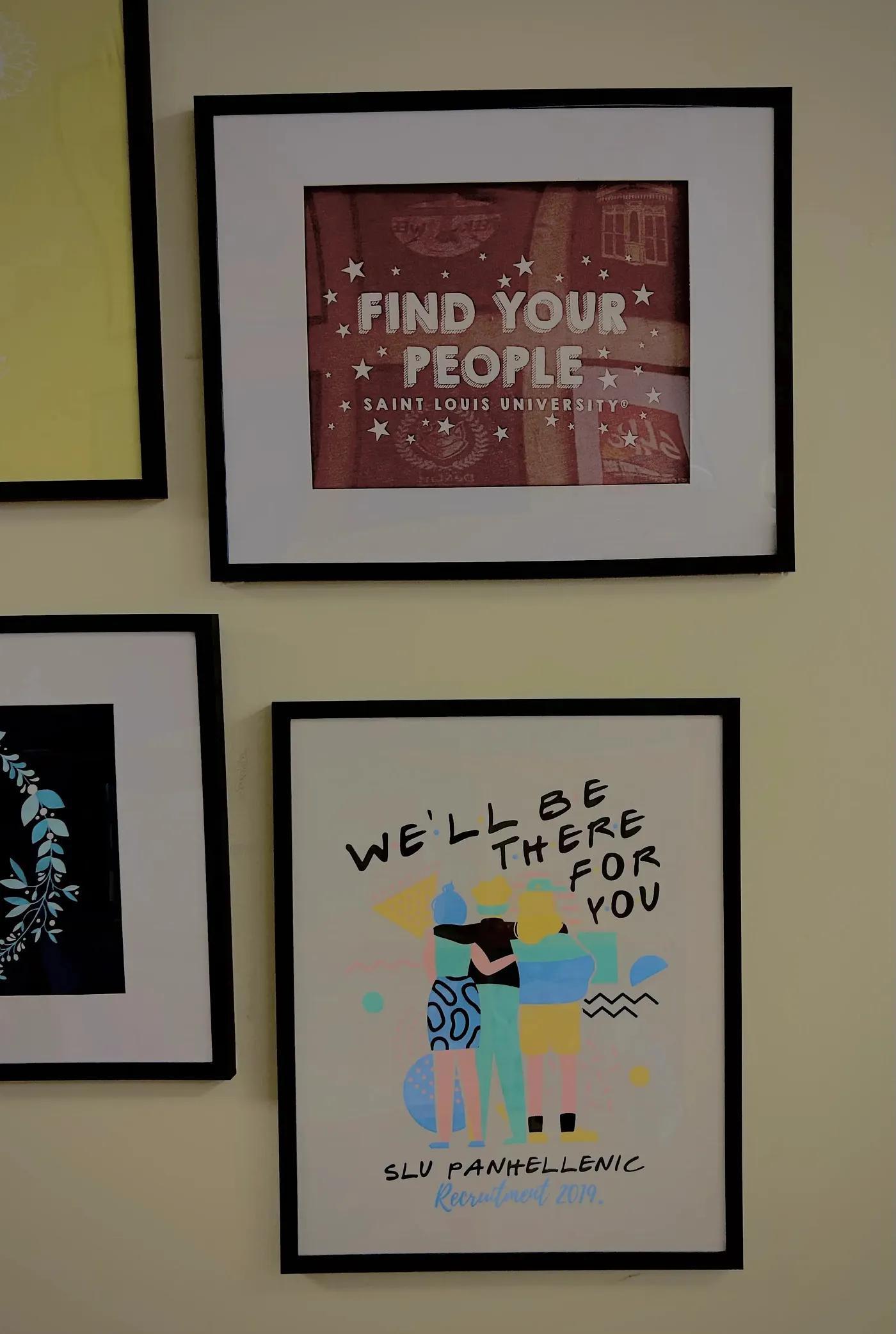
Fraternity and sorority life has been increasingly criticized for cliquishness, classism, homophobia and racial insensitivities. FSL at Saint Louis University has made changes in response to these criticisms and broader diversity, equity and inclusion waves across the country.
While both of SLU’s interfraternity (IFC) and panhellenic councils, who are separate entities under FSL, have implemented DEI initiatives in recent years, interviews with current and former members suggest that meaningful change is still needed. Despite newly added positions, programs and required discussions, stereotypes, homophobia and racial microaggressions still persist in Greek life.
The IFC oversees nine fraternity chapters on campus, while the panhellenic council oversees seven sorority chapters. These two organizations have rules and regulations that apply to all chapters, but some individual chapters have further requirements for things such as DEI.
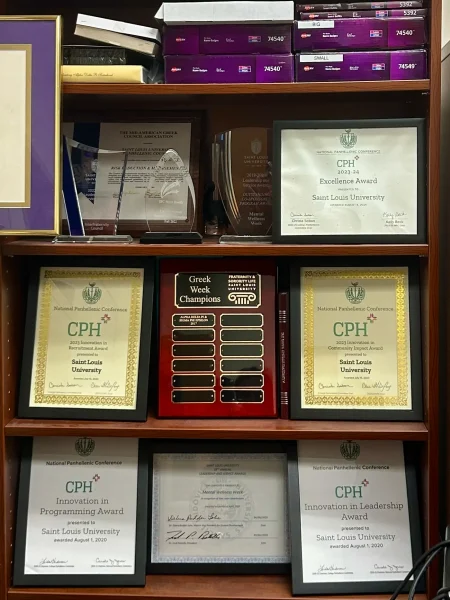
This looks quite different between the sibling councils. The IFC instated a VP of DEI in 2022, and members said that while some chapters created DEI chairs, others would only meet with the VP on occasion.
Comparatively, panhellenic established the VP position in 2020, developed a DEI speaker series in 2022 requiring all sorority chapters to maintain 25% attendance at the monthly events and initiated a DEI chair in each chapter; sometimes, these events would be attended by IFC members as well, though the organization never conducted anything of their own, according to their members.
A former SLU fraternity member, who requested anonymity out of fear of harassment, said that fraternity life’s hypocritical engagement with philanthropy motivated him to leave his fraternity after two years.
“Come to find out, none of the people in the fraternity actually represent those values,” he said, referencing a fraternity whose philanthropy supports a woman’s safe house. “Those are not joking matters. These are people’s lives that are being ruined by this stuff. And very, very often, jokes about women would come up that aren’t tasteful in the slightest.”
He said that sexist jokes were common in the fraternity, with multiple jokes told during outings and entertained within groups. He also said that some of the fraternity members who had Title IX violations had attended these safe houses, engaging with the women and making jokes after.
The former fraternity member said that despite the additional DEI efforts within the IFC, the extra DEI chair position established in some chapters was simply a line of communication to the supervising VP of DEI in the IFC. Their primary responsibility was to communicate to the VP if blatant discrimination was taking place.
Despite this, some fraternity chapters don’t have a separate position for DEI and instead choose to add DEI responsibilities to existing positions. This was the case for senior Erald Murati, the former vice president of community engagement of Sigma Tau Gamma fraternity. While he was a determined advocate for DEI, he said that the combined nature of the role did not allow him to give DEI as much attention as it needed.
“I had so much to do with my position. I was in charge of philanthropy week, alumni, staff, parents, Greek Week facilitation and more. It’s really difficult to dedicate enough time, and I think DEI unfortunately always falls to the wayside because it’s seen as less important,” Murati said.
Murati said that despite fitting the white male demographic, being an openly gay man while being responsible for educating his peers put him in a difficult position, as he wanted to help them be better people, he said. To implement DEI in their chapter meetings, Murati would host presentations or discussions about topics under the DEI umbrella once a month.
“Looking back, I made a lot of mistakes, in the sense that I felt like I had to educate so much, and with, you know, slur usage. It’s no shock that a lot of fraternity spaces still use slurs,” Murati said. “I made it clear that I don’t like [slurs] being used, and that it’s hurtful and harmful even if there’s no one around that hears it.”
The anonymous former fraternity member previously mentioned attested to this experience, saying he would often hear fellow members making out-of-touch and racist jokes.
“I’ve experienced indirect racism; people that just have incorrect misconceptions about my people because of things that are unfortunately propagated all over the internet,” he said. “I can expect college-educated people to have a modicum of critical thinking and think, ‘Hey, you know, people don’t actually bathe in shit. People don’t actually cook with their feet, but anybody can be gullible.”
He said that there was no comfortable way to report such microaggressions within his fraternity chapter.
Another former fraternity member, who requested anonymity out of fear of backlash, highlighted the fraternity’s homophobia and lack of respect for mental health in a different fraternity.
“I would never say that anyone really went out of their way, in my experience, to be super racist or anything, but I did witness a lot more people being close-minded about LGBTQ+ people joining. I’ve also heard names of people in Beta that were very close-minded to everything; xenophobic, racist — everything,” he said.
According to him, the IFC would send their VP of DEI to meet with each fraternity’s chapter once or twice a semester. In these meetings, the VP would discuss what DEI is and why it is important.
“There were a lot of people in the fraternity that actually paid attention and really did engage in the presentation, but there were equally as many that were literally just like, ‘Okay, can we get this over with?’” he said.
There were other instances where members would be ridiculed for experiencing mental health problems as well, he said.
“I remember one person talking about how someone had to take a semester off [for their mental health]. And someone said, ‘You can’t use mental health as an excuse. You’re just clearly not cut out for college,” he said. “It’s the most ridiculous thing I’ve ever heard.”
The IFC declined to comment on DEI within their fraternity chapters.
DEI was implemented around 2022 in the fraternities – two years later than their sorority counterparts, according to various members. The panhellenic council created a VP of DEI position in 2020, later instating a DEI speaker series in 2022 in response to these changing dialogues.
“There was just a greater need for DEI. The community in general saw it as a point of focus and growth for the future in the community. This was an opportunity for education, especially,” program coordinator for FSL Maeve Wolf said.
The speaker series has been widely accepted in the community and has since grown in attendance and scope, according to Wolf. On average, the series saw about 214 members in attendance at each monthly event.

The events are exclusively for sorority members, but are occasionally in tandem with fraternities as well. Former VP of DEI for panhellenic, Libby Steilen, said that she was warned by her predecessor not to plan joint events with their IFC counterpart. She said she ended up doing all of the work.
“I ended up doing one [event] where I planned it and decided to invite IFC on voter registration – everyone would benefit from hearing this and it’s not a controversial topic,” Steilen said. “I’ve never seen anyone be so disrespectful to a speaker. [They were] talking when she’s [the speaker] fully talking on the stage and more, so I decided that I’m never inviting them back.”
She also added that during her early years of college, panhellenic had such difficulty getting fraternity members to attend DEI events that they had to provide a financial incentive for them to attend. The fraternity with the most attendance would get $200 towards their philanthropy, second would get $100 and third would get $50.
This lack of interest was not only in fraternities, Steilen said. It was often hard to keep sorority members engaged as well.
“It was really frustrating because I would bring in these speakers who were so well educated and who I thought were such cool people that I really cared about, but you just can’t get people to care. No matter who you bring in, people who don’t care about DEI are just not going to care about it,” Steilen said.
Steilen hosted speakers such as Vivian Gibson, writer of “The Last Children of Mill Creek,” a memoir about Mill Creek Valley, and speakers from external LGBTQ+ organizations and more for the DEI speaker series. She also hosted more casual student-to-student conversations on what it means to be queer in panhellenic. The speakers would come for free once a month and the sororities were only required to maintain a 25% attendance rate from all chapters.
“People were treating it like it was like a punishment or a chore,” Steilen said. “A lot of people would go there and sit in the back row and go on their computers the whole time, or go on their phones or talk to their neighbor.”
She also said that in private conversations surrounding DEI, sorority members would complain, asking if they “really had to go.” Despite being the one to plan the events, it was rare for her to hear praise for a speaker, Steilen said.
Another issue Steilen often faced was microaggressions towards the LGBTQ+ community.
“In sororities, a lot of comments or attitudes surrounding being lesbian or queer are very funny – as in they think it’s a joke, which is really frustrating, because it also makes it really difficult to try and report things,” Steilen said. “I’ve had people say microaggressions to me, and it’s really difficult to try and come to an executive board and be like, she said this, and it’s not blatantly homophobic, but they can’t be saying that.”
A current sorority member, who chose to remain anonymous to avoid backlash, said that in her sorority’s chapter, their DEI chair includes something at each meeting relating to DEI. Her sorority also made attending DEI speaker events count towards the required points each member needs to attend their end-of-year formal.
“I don’t think many people would take initiative in the DEI sense, but there’s a good intent behind requiring the sororities to go to the DEI discussions,” the member said. “I bet a lot of the girls do enjoy the topics of discussion at DEI events, but personally, if there wasn’t a fine over my head, I wouldn’t go.”
Although the events seemed dull and lacked lived experiences, the member said the speaker series has a good range of speakers on issues of redlining, St. Louis’s Delmar Divide, racial segregation, environmental awareness, mental health and more, she said.
“It feels a bit disingenuous, just because, again, the majority of the people in these sororities are white, and it feels like there’s not that much passion,” she said.
Senior Zeta Tau Alpha sorority member, Emma Segura, said that in her chapter they implement point systems to encourage members to attend events organized inside and outside of their chapter; members have to earn a certain amount of points for different categories, like DEI, to attend end-of-year formals and some sorority events.
As a Mexican-Honduran woman, Segura often finds that events for Women’s History Month and Black History Month feel more white-centered and glossed over.
“I don’t believe that this is on purpose or for any intent to be harmful, but what I would like to see prioritized more is discussing how to be more inclusive and awareness can be fostered,” Segura said. “I felt our women’s history presentation represented more white women and did not represent as many Black women as it could. As one of the only Latinas in my sorority, it was disheartening to not see any Latinas mentioned.”
Emily Tran, a senior member of Delta Gamma (DG) sorority, has been to four DEI speaker series events so far. Tran said she simply goes to the events because they are required, but has enjoyed learning about important issues.

“I feel like just for DG I do get more educated on different super duper awesome topics that aren’t really talked about,” Tran said. “So, I think it’s helpful and I feel like DG implements it. Obviously, more work still needs to be done, but I think we’ve definitely step foot into what we need to kind of kick start things off.”
Each sorority chapter has their own rules and regulations when it comes to DEI. While some chapters may implement fees, others implement weighted point systems. This is the same for fraternities as well, though they do not have event requirements according to their members.
In 2020, panhellenic established a $1,000 budget for DEI and Wellbeing, but this budget has since decreased to $500 in 2024. One of the main reasons for this decrease is how the budget itself is allocated. Last year, the funding changed to be only for DEI, representing 3% of their overall budget, according to Wolf, FSL’s program coordinator. Overall, FSL membership has also declined.
“We have seen a decline in membership,” Wolf said. “New members decreased by close to 32% in the last year. We are working with around a $5–10k budget, smaller than recent years.”
The decline in budget and membership has impacted panhellenic’s ability to reach out to well-known speakers and host bigger events.
Former VP of DEI for panhellenic Steilen said that this was not the only barrier in the role and speaker series. She said there was a lack of preparedness on the administrator’s end, which left all of the work to the student with little to no guidance.
“It was really hard to find all these speakers. I just sort of got thrown into this,” Steilen said. “Luckily, I am involved in a good amount of activism and knew some speakers who would be willing to do that, but I think that is the hard part. All of us are just college girls; we don’t know enough to be putting on this amazing DEI program that transforms our members.”
Murati, whose previous community engagement role included DEI, said not only is there little structure, but that it was hard not to sound “preachy.”
“What vocab do I use that doesn’t just come off as like, ‘Oh, well, Erald has to say this, because this is his position?’” Murati said. “You want to be candid using the word privilege, which is very charged in many different ways. I used to say [instead, that] some people may have advantages because of things they don’t get to choose, which, you know, is a definition of privilege. But sometimes it [comes off] different from just maybe stating it in a way people don’t expect.”
Despite these challenges, Murati left feeling hopeful that cultural change would take place and that he did the best he could, he said.
“I’m very thankful for what I’ve done in this fraternity. I’m very thankful that I did it,” Murati said. “The fact that I can sit here and tell a member if they did something wrong and they’ll understand where I’m coming from is wonderful. I’m glad I’m able to say I’m part of a group that fosters something like that.”



Sam • Sep 9, 2025 at 1:56 pm
I left my frat at SLU because all philanthropy money was spent on alchohol and partying. The frats are poorly ran with no guidance or accountability. My frat used to make the PNMs coverup an older member cheating on his girlfriend. They used to constantly belittle and talk poorly about our gay members and members of different backgrounds. My biggest problem was the amount of bullying of a member we had who was autistic, they would leave him out of everything including frat group chats. This was all courtesy of the president and others in charge in it and when I brought it up to nationals they tried to send me to collections when I had no outstanding payments. I threatened them with legal action and they backed off. I then left and never looked back. Frat: PKT