



As Missouri awaited Gov. Mike Kehoe’s decision on whether to halt the execution of death row inmate Lance Shockley, students at Saint Louis University joined Missourians to Abolish the Death Penalty, the only statewide organization dedicated solely to ending capital punishment in Missouri, in calling for clemency and raising awareness about wrongful convictions.
Shockley was convicted in 2005 of killing Missouri State Highway Patrol Sgt. Carl Graham Jr. near Van Buren, Missouri. He has maintained his innocence for nearly two decades.
Advocates note that no physical evidence tied Shockley to the crime, and the request for DNA testing of 16 pieces of evidence has not been granted.
In the week leading up to Shockley’s scheduled Oct. 14 execution, around 12 SLU students participated in petition drives, planned vigils and collaborated with MADP to urge state officials to reconsider the case.
Dr. Heidi Moore, executive director of MADP, an alumna and SLU employee of nearly 10 years, said the university’s Jesuit mission made it a natural partner for outreach efforts.
“SLU has been my family. It was natural for me to reach out to the SLU community first. The Jesuit and Ignatian principles align with not killing citizens, even state-sanctioned,” Moore said.
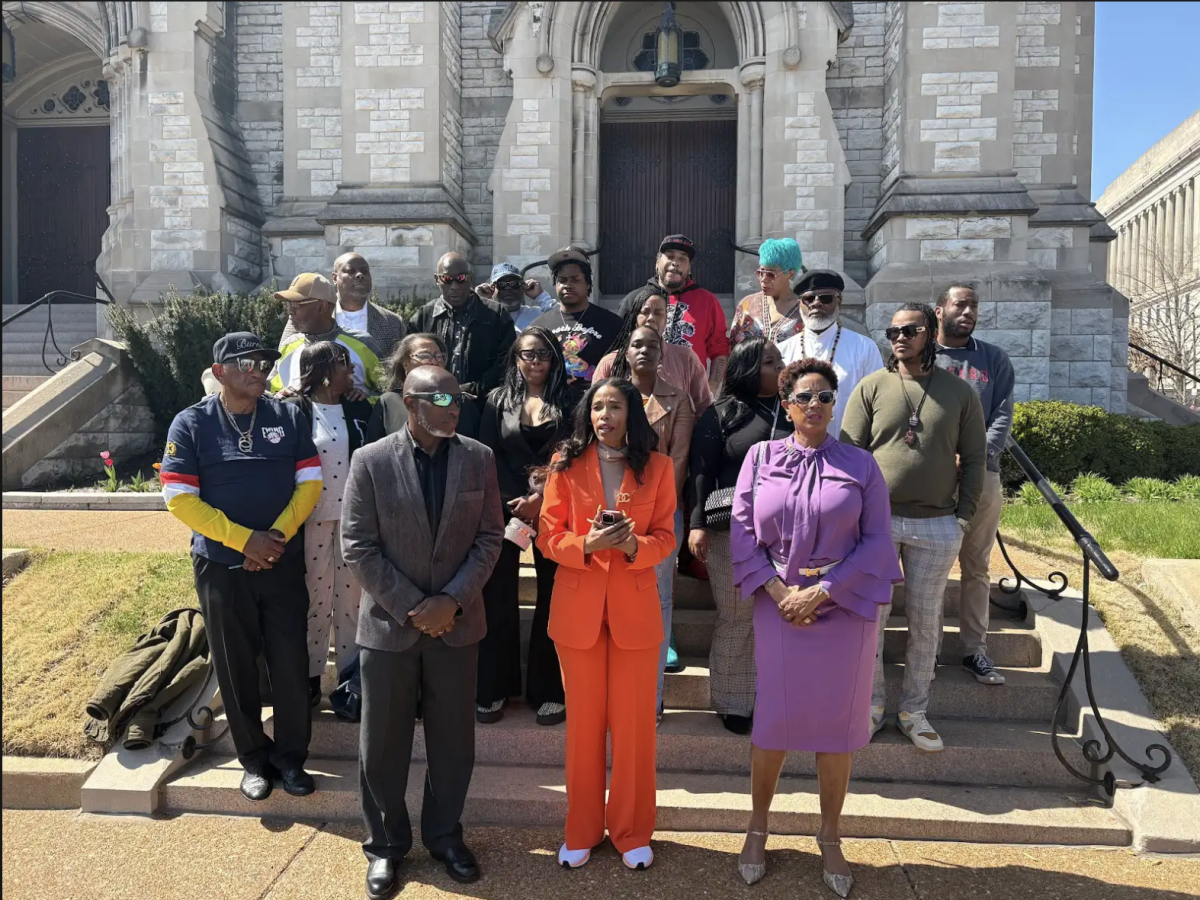
MADP held its St. Louis vigil at St. Francis Xavier College Church on Oct. 14, marking a return to campus after several years of off-campus events. Moore said public engagement events like these are central to achieving the organization’s mission.
“Our vigils used to be at College Church for every execution. I pushed to bring them back because SLU students are more likely to get involved if it’s visible, right where they walk by every day,” Moore said. “We’re raising awareness with events like this across the state. Even among people who support the death penalty, there’s growing discomfort when there’s doubt about a person’s guilt.”
Despite calls across the state, Kehoe declined to grant clemency, and Shockley was executed by lethal injection at the state prison in Bonne Terre, Missouri, on Oct. 14, according to the Missouri Department of Corrections.
Zachary Geller, a junior involved with the criminal justice policy pod at SLU, worked closely with MADP to petition for Shockley.
“I was extremely disappointed and saddened that he was denied clemency, especially knowing that it was his last chance,” Geller said. “After the fact, I attended the vigil held at the university church and paid my respects.”
Shockley’s execution was one of six scheduled nationwide between Oct. 10 and Oct. 17, part of what Death Penalty Action described as the highest pace of executions in the U.S. in more than a decade.
Dr. Kenya Brumfield-Young, a SLU criminal justice professor who works closely with the Midwest Innocence Project (MIP), said the Shockley case helps students understand the realities of systemic failure.
“When students study wrongful convictions, they learn not just what happened, but how it happened. They start to see that wrongful convictions aren’t always the result of malicious intent, [but] they can come from systemic failures, faulty evidence or forensics,” Brumfield-Young said.
Brumfield-Young said that challenges of wrongful conviction extend beyond the legal system, emphasizing who exactly is harmed in cases like Shockley’s.
Before leading MADP, Moore worked for the Missouri Department of Corrections, including a position at Potosi Correctional Center, where individuals sentenced to death are housed.
“I’ve seen firsthand how executions affect not just those sentenced, but the staff who walk them to their deaths,” Moore said.
According to Death Penalty Action, three people with October execution dates, including Shockley, have ongoing innocence claims. Nationwide, around 3,700 people have been exonerated since 1989, including 201 who were sentenced to death, according to the National Registry of Exonerations.
Missouri currently has 29 people on death row, according to data from the Death Penalty Information Center. Missouri, along with Indiana, is one of two states in which judges can unilaterally impose the death penalty when a jury cannot agree on whether the defendant should be sentenced to death.
In most other states, a deadlocked jury results in a sentence of life without parole. In Shockley’s case, his jury of peers was deadlocked, resulting in the judge convicting him of first-degree murder. This decision was upheld by the Missouri Supreme Court, the federal district court, the 8th U.S. Circuit Court of Appeals and the Supreme Court.
Moore said cases like Shockley’s can be a starting point for public dialogue.
“Lance’s case is the kind of case people should use to talk about the death penalty,” Moore said. “It’s a safe entry point. Even people who support capital punishment can look at this and say something feels wrong.”
Although Shockley’s execution was not halted by the governor, both Moore and Brumfield-Young said the case reflects larger lessons about justice and engagement.
“Each case represents human life,” Brumfield-Young said. “It’s not about sensationalism. It’s about understanding that when the system fails, it fails real people. Student voices can push those conversations forward.”
Shockley’s execution proceeded as scheduled, despite calls from students and advocates. His case continues to be cited by anti-death penalty groups as an example of the risks of wrongful conviction and the human impact of capital punishment.
Moore said she hopes students will continue using their education and advocacy to influence policy.
“Students have power,” Moore said. “Even if they can’t change the whole world, they can change their part of it.”



Nadia Pflaum • Oct 20, 2025 at 11:47 am
Bravo to these students. Keep up the fight!