
After the President’s Office announced the simultaneous closing of the Division of Diversity and Innovative Community Engagement and creation of the Office of Belonging in an email on Oct. 22, the broader Saint Louis University community had mixed reactions and feelings.
DICE oversaw programs such as the Cross Cultural Center and the Center for Social Action, as well as providing diversity, equity and inclusion resources across campus and within their designated space in the Center for Global Citizenship to make students of all backgrounds feel welcome.
Rochelle Smith, former vice president of the now defunct DICE and Chief Belonging Officer, said that she sees the new office as an “institutional scaling up” of the work previously led by DICE, emphasizing the office’s ability to enact institution-wide change.
“We had a ‘Belonging at SLU’ campaign and initiative when I first started at Saint Louis University, so we decided to expand on that and make it the whole work,” Smith said. “In this way, we can make the institution better for thousands more students, thousands more staff and thousands more faculty.”
Amaia Corta, a junior studying political science, said they were hesitant to believe Smith’s view, fearing the opposite effect might happen.
“I personally feel that this is a slap in the face. I feel that it only serves to embolden the university to become more conservative, and not even politically conservative, just socially conservative in a way that goes against our Jesuit values,” Corta said.
In the face of increased federal pressure on DEI initiatives and offices in higher education by President Donald Trump’s administration, Smith said that new SLU President Edward Feser would have made this change regardless of the political landscape.
“We are not walking away from our mission. We are not walking away from the work,” Smith said. “This is not an answer to the Trump administration.”
The Office of Belonging’s creation was spearheaded by Smith, Feser and former President Fred Pestello, with Feser suggesting the focus on belonging at the beginning of this fall semester. The change was not communicated to faculty and staff outside of the President’s Office before the email announcement.
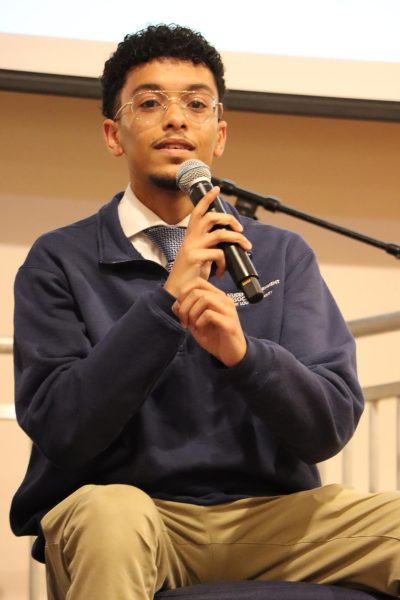
Corta said that this lack of communication was unacceptable and widely felt throughout various departments.
“From what I personally have heard … they did not engage one single head of department. Not the head of the African American studies department. They did not talk to the head of the American Studies department. They did not talk to the head of the political science department. They did not talk to any of the department heads,” Corta said. “There was no warning.”
Dr. Katrina Thompson Moore, a professor in the department of African American studies and associate dean for DICEt in the College of Arts and Sciences, said that the news of the Office of Belonging left her with many unanswered questions, particularly concerning the name.
“I want to know what SLU means by belonging. I want a very clear definition. Belonging does not take the place of diversity, equity, [and] inclusion. It can’t, no matter how you define it,” Moore said.
President Feser said that this is not a loss, but an opportunity to fill in the gaps and increase the effectiveness of DICE’s work.
“What I want to see happen with the Office of Belonging is, we have a very good strategy that’s institutional and organizational, and we make sure that where we deliver programming, we’re delivering it in places where we can achieve maximum effect in scale,” Feser said. “That’s really what the shift is.”
As the office begins its operations on campus, it will focus less on specific programming and more on institution-wide change. Within the institution, Smith said this broad focus will include the office advising departments on increasing the inclusivity of SLU’s culture, consistently conducting assessments and tracking outcomes, and providing guidance on curriculum and pedagogy. Beyond the institution, Smith said that these practices will maintain healthy relationships with community leaders.
Smith confirmed that no programs previously under DICE will be cut directly, but could not give a certain response on potential future reallocations.
“For example, the Cross Cultural Center came from student development, so it’s likely that it will go back there. For example, the Center for Social Action is rooted in our Jesuit mission, so it makes sense that that will likely go to mission and identity. So it was just what felt natural, and the team understands that,” Smith said.
Yet, for many in the SLU community, it is still unclear exactly what this means for the programs under DICE.
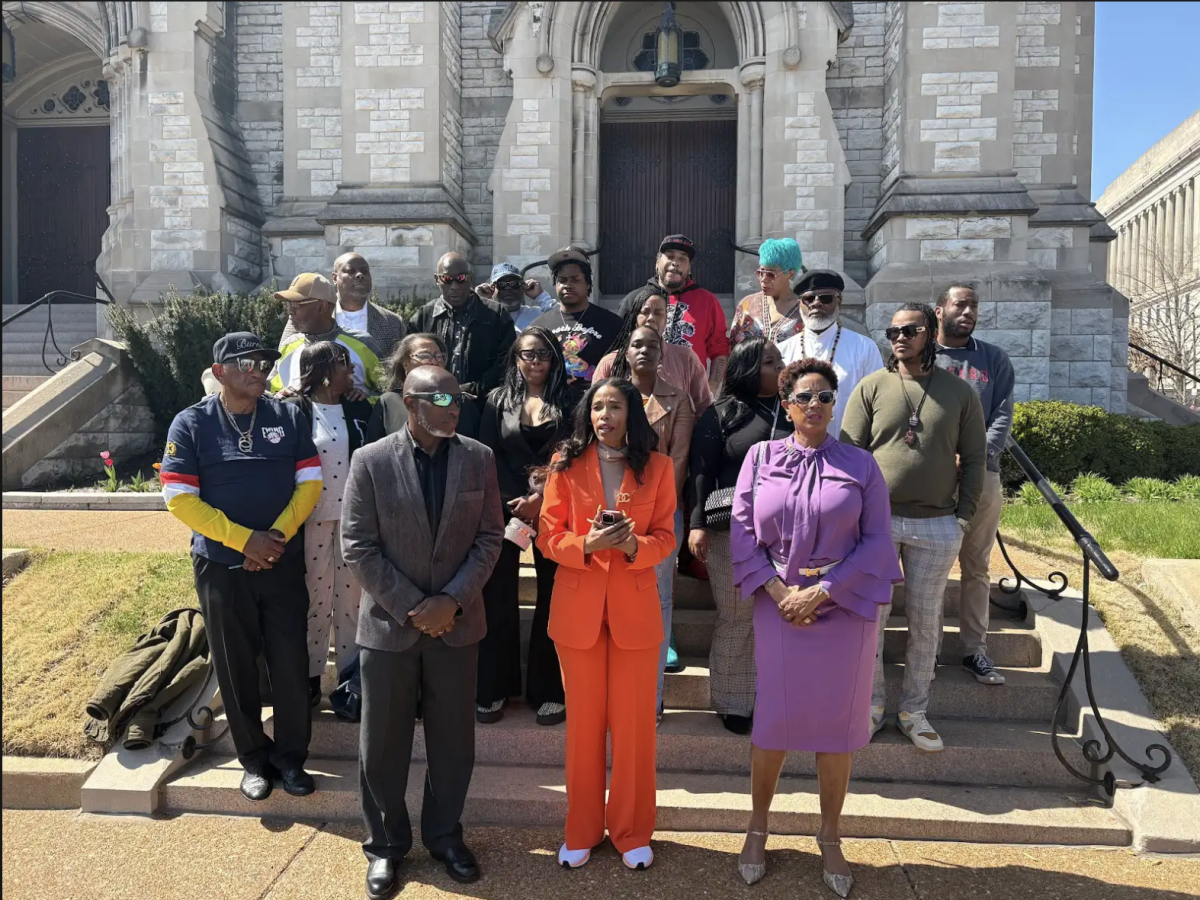
Corta, also a member of Occupy SLU, said in the midst of all these changes to DICE and DEI, the coalition is concerned about their future on campus.
“We’re deeply concerned about the abolition of DICE because the Clock Tower Accords fall under that and certain accords that are very specific could be affected, such as accord one, which has to do with increased funding to the African American Studies department, and accord two, which is increased funding for retention rates for African American students,” Corta said.
Occupy SLU also said that the timing of the email raised concerns. The email was sent at the end of the workday on the day before SLU’s fall break began.
Corta said that the coalition will push back against what they view as the dismantling of DEI programs through unclear policy changes.
“We definitely feel more emboldened to make our presence known, we feel more emboldened to let the university know that students are not going to stand for the complete abolition of DEI, especially when it’s done in such a coded, malicious way that it’s intentionally done to confuse and misrepresent the true intentions,” Corta said.
Robin Proudie, founder and executive director of the Descendants of the St. Louis University Enslaved, Inc., said she remains hopeful that this change will mean a more successful relationship between the institution and DSLUE.
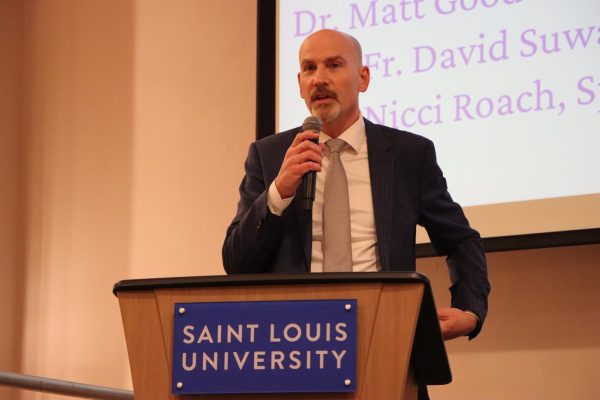
“If this is President Feser’s plan, let’s see if this makes things better or if this is just a way to phase out DEI,” Proudie said. “Personally, I believe it’s about the work that’s being done. I don’t care what you call it, ‘DEI, Belonging, Truth Healing and Reconciliation’ whatever. As long as it leads to an inclusive, transformative outcome, then let’s get to work to make that a reality.”
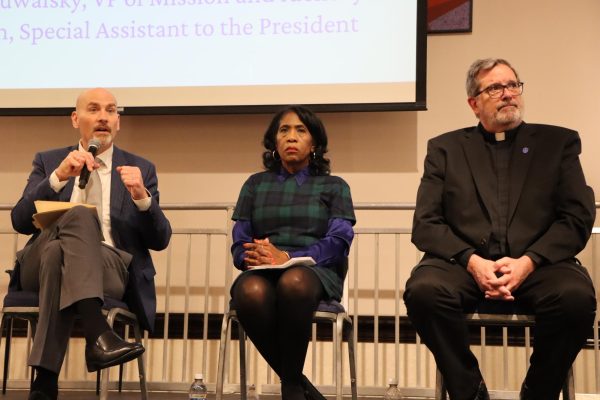
At a panel organized by the Student Government Association to answer student questions about the new office on Nov. 18, many students voiced concerns that panelists, including Smith and Feser, were not directly answering their questions or addressing their concerns.
Nila Milo, an MLK scholar and senior studying environmental science, said that she left the panel feeling more confused.
“I feel like my questions weren’t really answered by the panel and I also feel that my peers and other people in the community didn’t have their questions answered … I think that their language was so fluff that it kind of hindered almost everyone’s understanding of what was actually happening,” Milo said.
Feser and Smith did not directly address the Trump administration during the panel, fueling student dissatisfaction around the university’s response, or lack thereof, to federal attacks on DEI.
Milo raised concern at this lack of comment, and said that she felt it sent the wrong message to a campus that places great emphasis on social justice.
“When confronted with people’s feelings and interpretations with how it could be connected to the hateful comments that the president of the United States has been engaging in recently, and honestly for a long time, I think that it sends the wrong message about our university, or maybe it’s the message that they’re trying to send, I’m not really sure. It’s hard to say with their choice of language and verbiage,” Milo said.
Overall, the SLU community wants transparency, and the chance to see the work that the Office of Belonging has promised to accomplish.