
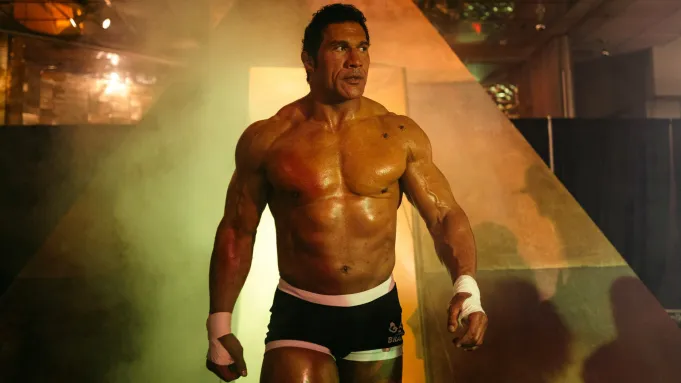

A big man with a “live loud” personality and a stacked wrestling background, Dwayne “The Rock” Johnson has never been one for subtlety. Since he joined the film industry, he has often preferred the loud, good-guy role, with no room for real nuance or complexity in his characters. While he has delivered billions in box office returns across his long career, he has never delivered a truly profound performance until his most recent film “The Smashing Machine” from director Benny Safdie.
The film follows the real-life story and struggle of former MMA fighter Mark Kerr, who dealt with substance abuse while being at the top of the fighting world in the early 2000s. His meteoric rise and subsequent fall have been a point of constant discussion within the MMA community for the past few decades, even spurring a well-received HBO documentary in 2002 also named “The Smashing Machine.”
At its core, the film is a relationship drama, following the lives and interactions of two explosive personalities as they attempt to stay together, despite their obvious issues and incompatibilities. Mark Kerr and his girlfriend Dawn Staples, played by Emily Blunt, go through this time together as he becomes increasingly more famous in the wrestling community. We see how Kerr’s struggles change the duo’s already rocky relationship. Their fights reflect Kerr’s fights inside the ring, as we see them land metaphorical jabs at one another, ending each interaction with one loser and one winner.
The film is carried by the performances of Johnson and Blunt, who portray the desperation and anger of these two complex people in a compelling manner. Both characters are flawed, and they prefer to fight one another rather than actually talk. But beneath all their anger, the pair clearly love one another, which makes their story gripping.
A shocking aspect of this film is that Johnson’s persona truly does disappear into his role as Kerr. Johnson comes from a similar background, originally being a wrestler before pivoting to entertainment, something that clearly shines through in his performance.
Johnson truly became Kerr for this film, adopting his mannerisms and generally depicting him as a gentle yet conflicted giant, kind to all around him but harboring immense pain. The audience sees how Kerr attempts to hide his internal fear and anxiety with success and positivity.
Viewers will no longer see “The Rock,” but simply a complex character played by a talented actor. And thanks to some extremely well-done prosthetics, he even looks like Kerr.
Outside of the core duo, however, the film is rather lacking. It is clear that Josh and Benny Safdie, brothers and frequent film collaborators, create their best work together, as the solo work from Benny here feels like it is missing something.
A lot of the film feels rather one-note, with the same speeches and interactions happening over and over again, with no actual plot development occurring. While this may be an attempt at depicting the repetitive cycles those who experience substance abuse or endure toxic relationships live through, the idea is executed poorly.
Benny Safdie attempted to make this film extremely realistic to the sport and era, portraying the wrestling community as it was decades ago by employing several real wrestlers and using the storylines of Pride Wrestling in the 2000s, the pinnacle of fighting in Japan.
This does, however, backfire with the casting of character Mark Coleman, widely considered one of the most notable MMA figures of all time. Safdie’s selection of Ryan Bader, another former professional wrestler, did not pan out well. Bader, unfortunately, doesn’t possess much acting prowess, more often delivering his lines like a robot, making the scenes that include him rather difficult to watch. However, it does have the unexpected effect of showing how well Johnson’s acting has come along. He commands nearly all of the scenes that the two share.
Another issue is that the plot feels finished at several points, but the film continues beyond what could’ve been a conclusion and goes in a different direction. Rather than setting up different problems at the beginning of a film and systematically resolving them, “The Smashing Machine” tries to focus on a single issue and solve it again and again, to an unnecessary and redundant extent.
Despite the messy plot, the film’s soundtrack stands strong and is very well suited to both the film’s overall vibe and the development of its plot. Safdie includes a plethora of needle drops, placing several songs throughout the film that add beautifully to their scenes.
Channeling a 70s and 80s vibe, the music helps to inform the audience on the environment in which the characters actually lived and what songs they grew up on.
While this film is in no way an Oscar’s Best Picture winner, it is still a deep and contemplative character study on one of the early pioneers of MMA fighting. Despite the film’s broader issues, Johnson truly deserves his flowers for depicting Mark Kerr with nuance and complex emotions, producing something truly beautiful.