
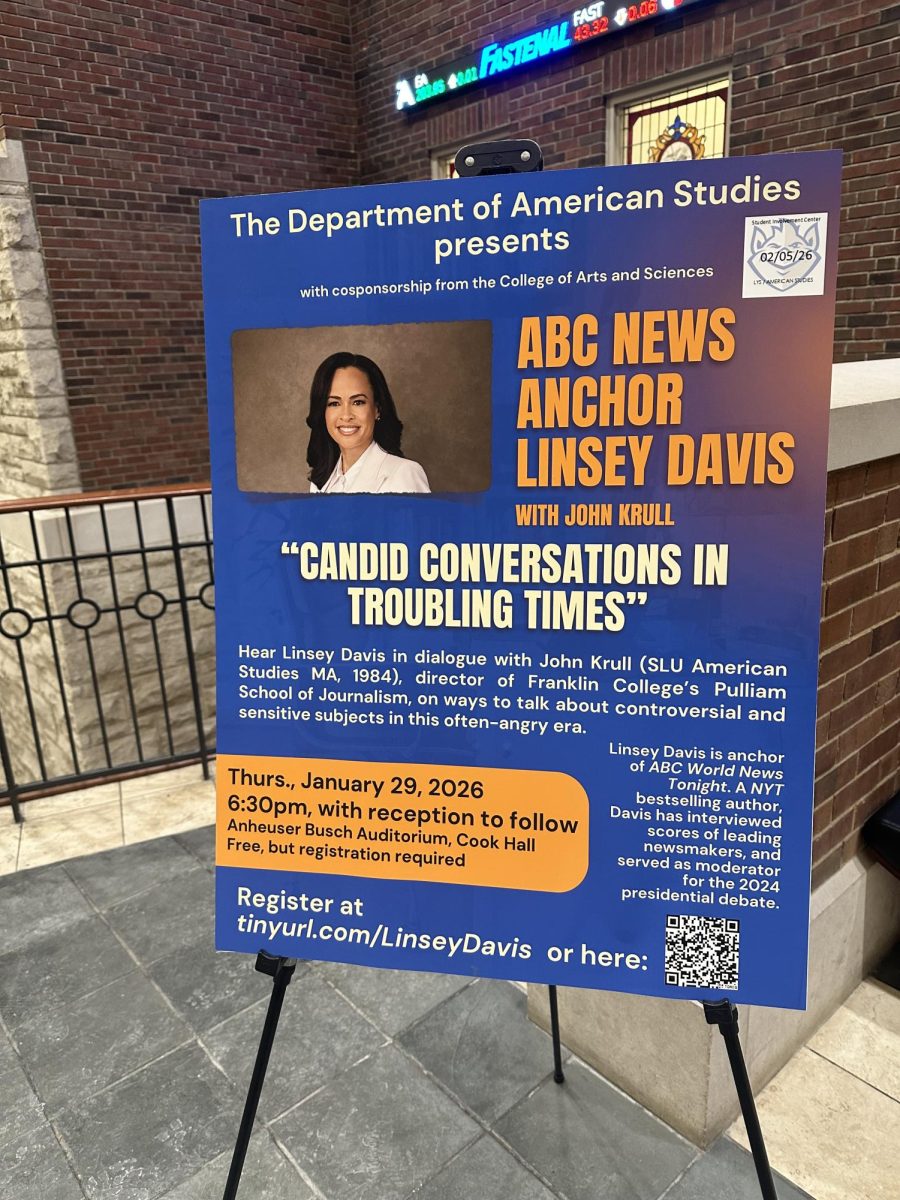
Saint Louis University’s department of American studies and College of Arts and Sciences co-hosted ABC’s Linsey Davis and SLU alum John Krull to speak to students, staff and community members about the importance of journalism in this day and age.
Donna LaVoie, the dean of the College of Arts and Sciences, introduced Davis and Krull and explained the mission for hosting the event.
“In a time when public discourse can feel fractured, the interdisciplinary lens of American studies provides something essential: the capacity to connect ideas, question narratives and discern meaning amid uncertainty,” LaVoie said.
The conversation is being held at a time when there has been a rise in instances of censorship of student journalism and media since late 2024. For example, at Indiana University, where the student newspaper’s faculty advisor was fired after refusing to comply with the university’s order to “print no news in the newspaper.”
In November 2025, The University New wrote an editorial in response to the situation at Indiana University.
The event, called “Candid Conversations in Troubling Times,” allowed attendees to submit questions for the speakers to answer during the talk.
Krull is a professor of journalism at Franklin College, where he got his bachelor’s degree in journalism and history. He later studied at SLU to get a master’s degree in American studies.
Krull began the interview with Davis, who shared a little bit about herself and how she became a broadcast journalist and anchor.
Davis began as a psychology major at the University of Virginia with no plans of becoming a journalist. While studying abroad in London, she took journalism classes that inspired her to pursue the profession. Davis later completed her master’s in communication at New York University.
When Davis began her career in broadcast journalism, she was a reporter before she became a weekend anchor in Indianapolis, Indiana. Davis shared that she prefers reporting to anchoring.
Then in 2007, the ABC News network hired her on as a reporter for Good Morning America, 20/20, Nightline and World News Tonight, where she anchors on Sunday nights.
Other titles Davis has are children’s book author, marathoner and mother.
The tone shifted to a more serious conversation as a question was asked about the media coverage of the tragic events in Minneapolis, where aggressive ICE raids and enforcement led to the fatal shootings of Renee Good and Alex Pretti.
Davis and Krull touched on the fact that in other periods of history, the first to attack injustice is the media, whether it’s news or social media.
“It was fortunate on the side of truth that there was video,” said Davis in regard to the murder of Alex Pretti. “I don’t see my role [in media] as getting you to determine something. I am a purveyor of information, of truth.”
Davis and Krull acknowledged that there is some distrust of the media.
“A reason why trust is so fragile now is because there are so many more people speaking,” said Krull.
Davis then explained that people turn to the news to see if their world is safe.
“There is an understanding that there are still places you can turn to for the truth and greater understanding,” said Davis.
As the discussion deepened, one question cut to the emotional core of the profession: How do journalists stay human while covering conflict, tragedy or social unrest?
Davis shared that her faith and running are her escape when she is at home with her family.
“At home, I don’t watch the news. I try to find some outside distractions,” Davis said.
Krull answered from a different perspective.
“You have to allow the humanity you possess to guide you,” said Krull. “You have to allow yourself to feel.”
Krull referenced a moment when he told his editors at the Indianapolis News that he could no longer cover drive-by shootings, as they had become too much to handle.
“Don’t be afraid to stand up for yourself, take care of yourself,” said Krull.
Both Davis and Krull are involved with Trust for Trauma Journalism, an organization that supports journalists in reporting on traumatic experiences while also helping them care for their own well-being as they encounter trauma in their work.
As the conversation came to a close, Davis and Krull’s message to students was clear: journalism is not just about reporting facts, but about caring for the people behind them — both audience and reporter.
For the students in attendance, the discussion served as a reminder that telling the truth is difficult, but necessary work, especially in troubling times.