
On March 1, MOCRA celebrated the opening of its final exhibition, “Liminal,” which will be on display through May 31 with a final celebratory event on April 19 at 2 p.m.
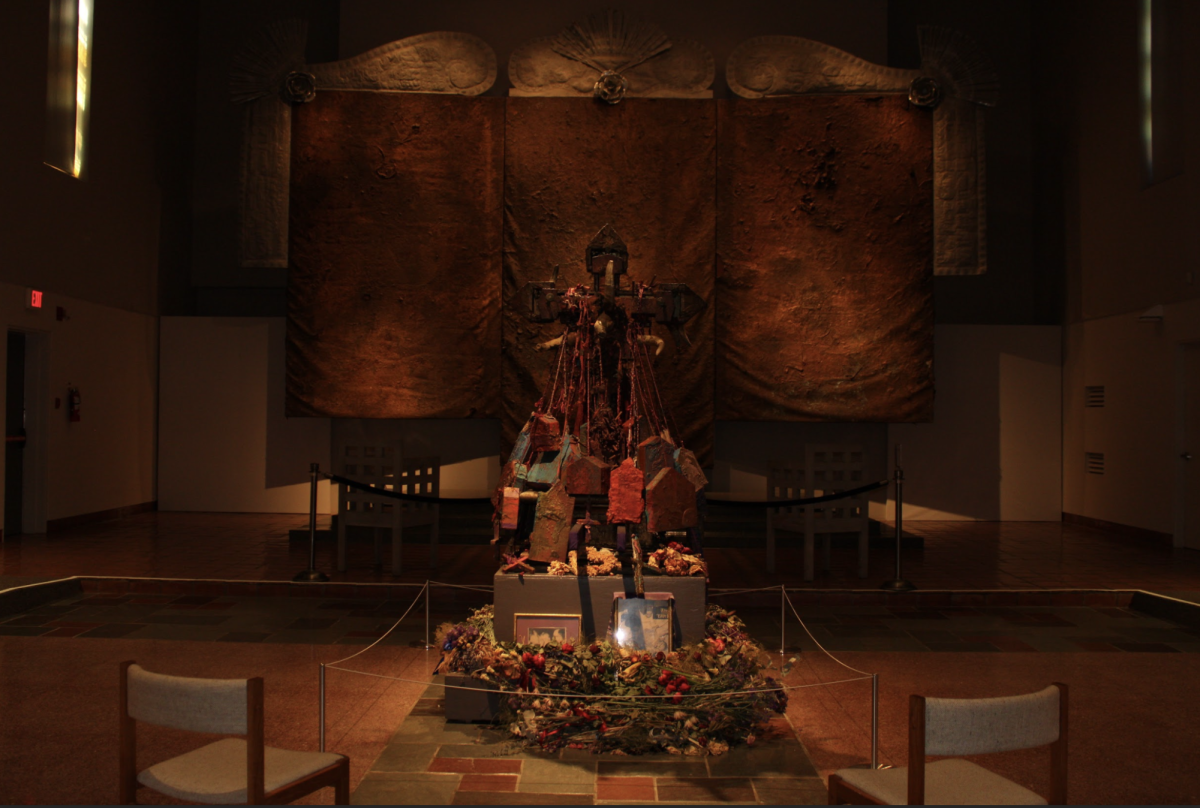
When preparing for the museum’s opening reception, director David Brinker made final touches to the lighting and set chairs throughout the main hall of the Museum of Contemporary Religious Art. Pointing to two oversized chairs facing the former Jesuit chapel’s altar, he said people will sit there for up to 30 minutes. For Brinker, the chairs are more than a place to rest one’s feet: The space invites reflection.
Brinker began working at MOCRA in 1995 under founder Terrence Dempsey, S.J., before taking over as director in 2019. Now, he looks back on his 30-year career with MOCRA and prepares to close its doors for good at the end of the semester.
“As a staff, we try to make MOCRA a space of welcome,” Brinker said. “I hope it has been a good example of inviting dialogue, welcome and contemplation.”
The exhibition honors the legacy of MOCRA as the museum enters a liminal phase of its own.
According to MOCRA’s exhibition brochure: “In a liminal phase, we transition from one status to another, a condition of uncertainty and possibility. What was familiar passes away; what is to come has not yet arrived. We may reflect on the past and envision the future.”
Four guest curators worked on the selection for “Liminal.” Brinker said that he asked them to find a piece from a new artist and put it in dialogue with a work from MOCRA’s collection to emphasize their variety and mission.
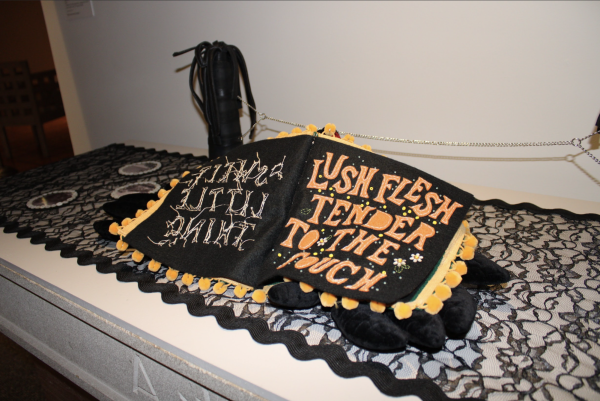
“We have folks who have been coming here for all 33 years, and so they need an opportunity to say goodbye to the space. They’re going to want to see some old friends, if you will,” Brinker said. “By doing that, folks who are coming for the very first time are going to get a very good sense of what we’ve been about.”
Brinker said MOCRA achieved this by including many of the common themes or visual traditions of previous exhibits.
“There’s a whole thread of our stuff that has been about what’s called the sublime and sort of more abstract geometric stuff,” Brinker said. “We’ve had a lot that really leans into suffering, challenge, difficult topics, some of those harder realities, but always underlying with some sense of hope, some renewal.”
In March 2025, SLU announced that MOCRA will close at the end of the 2025-26 academic year due to budget cuts.
In fall 2024, the university announced plans to reduce its operating expenses by approximately $20 million in fiscal years 2025, 2026 and 2027. According to an update on SLU’s FY26 budget from President Edward Feser, federal changes in international enrollment and research funding led to unexpected costs. Feser said SLU’s plan focuses on aligning resources with strategic priorities, including research infrastructure, academic distinction and impact.
Since the cuts were announced, Jennifer Nutefall, dean of University Libraries and Museums, said her department faced challenges in filling vacant positions efficiently. The university’s museums have three full-time staff members: two for SLUMA and the Cupples House, and one for MOCRA.
“It really is a sustainability question,” Nutefall said. “There are just not enough people to do the work of that many museums. I didn’t feel I could justify going forward and saying I need a brand-new full-time position for MOCRA.”
Nutefall consulted the executive director of museums and galleries about closing MOCRA, then held internal conversations with the provost, president and vice president of the Division of Mission and Identity.
Robert Hughes, interim chair of the Visual and Performing Arts Department and member of the arts council, said faculty described the announcement as unexpected.
“As an arts council, we wrote a letter to Dean Nutefall acknowledging the challenging economic state of affairs,” Hughes said. “We said that there wasn’t apparently any consultation with the department or other stakeholders. It is a unique place; people use it. What can we do to save it?”
Cynthia Stollhans, a professor emeritus, taught alongside Dempsey in SLU’s art history department, but the two first met while completing their master’s degrees at SLU. Upon completion, Dempsey went to the Graduate Theological Union at Berkeley and wrote his dissertation on contemporary religious art.
Dempsey’s dissertation became the foundation for MOCRA. When Dempsey returned to SLU, he received support from former president Lawrence Biondi, S.J., to repurpose Fusz Memorial Chapel. Since opening in 1993, MOCRA has been described as the only museum of its kind. Stollhans said that Dempsey’s vision emphasized innovation and diversity.
“He really did hit upon something significant that modern art historians had not really been addressing. He didn’t limit the art to a religion,” Stollhans said. “He really sought the spirituality in the art of any artist working and representing any religion.”
MOCRA has become a leader in contemporary art, working with hundreds of artists and galleries nationwide and attracting visitors globally.
The message and themes behind MOCRA reflect those of the university. Brinker said he works with faculty in diverse disciplines, even connecting with pre-health courses.
Stollhans said the exhibitions often explored difficult subjects. She referenced the 1994 exhibition, “Consecration: The Spiritual in Art in the Time of AIDS,” and Andy Warhol’s “Silver Clouds” as two standouts that challenged stereotypes in religious art.
“He had artists bringing up the beautiful and the not-so-beautiful,” Stollhans said. “It was on the cutting edge of what somebody could do with art.”
Adrian Kellard, whose art was featured in the Consecration exhibit, is again featured in “Liminal.” Curator and St. Louis local Jessica Baran paired his piece “The Promise” with “Devotion” from new artist Janie Stamm. Baran said that art is often a vehicle for remembering what history books may forget.
“To threatened communities where traditional legacy structures might not be available … art often is a kind of archive that is passed along and keeps these histories alive,” Baran said.
Just as unique histories will continue to be passed down, MOCRA’s art and legacy will continue to be shared. Nutefall said plans are in place to install a gallery to showcase artwork from its permanent collection in SLUMA.
“We are continuing that spiritual mission by having it integrated and not separated,” Nutefall said. “This is trying to combine resources so that we can raise the visibility of the art.”
While the art itself will be preserved, Brinker said it won’t be the same.
“You’re not going to replicate this anywhere else,” Brinker said. “When MOCRA closes, MOCRA has ended.”
Brinker said he does not want to give the impression that these exhibitions can not be displayed beautifully in SLUMA, but feels what made MOCRA unique was having a distinct space.
Stollhans said she has concerns about the works losing their impact without being set in a religious space.
Bradley Bailey, a SLU art history professor, said that MOCRA’s closure raises questions about the gallery’s role.
“There are some institutions that are bound to the space,” Bailey said. “Is the institution of MOCRA the space, or is the institution the collection?”
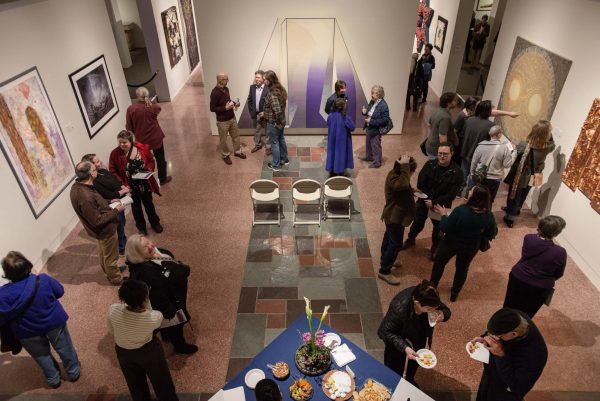
Still, people on campus and off recognize MOCRA’s artistic value as a pioneer in contemporary religious art. More than 140 people attended the reception, including some visiting for the first time in decades.
As Brinker revealed the exhibition to attendees at the opening reception, he said what he would remember is the little moments that confirm MOCRA has succeeded in its mission.
“I learned to see that moment where a visitor connects with a work of art,” Brinker said. “Sometimes it’s a look in their eyes, something they say, just a shift in their body. Knowing that we’ve been able to make that connection possible is the most rewarding part of the job.”