
While Jhumpa Lahiri was waiting at LaGuardia Airport in New York to receive the St. Louis Literary Award, she read her friend Barringer Fifield’s book “Seeing St. Louis,” where he wrote: “Paradoxes scan St. Louis history like the tolling of a cracked yet still sonorous bell.”
“That really struck me,” Lahiri said, “because I think a lot of my work is about thinking about paradoxes of the human condition.”
Lahiri received the award in a ceremony on April 8 at the Sheldon Concert Hall, joining the ranks of celebrated contemporary authors such as Margaret Atwood, Jamaica Kincaid and, most recently, Colson Whitehead. She also gave a craft talk on April 9 at Cook Hall.
This is the first year the award was hosted within the College of Arts and Science’s new Center for Literary and Creative Arts. The CLCA aims to spotlight the visual and performing arts as well as literature while conducting more community outreach.
Lahiri won a Pulitzer Prize for her short story collection, the campus read for this year, “Interpreter of Maladies,” in 2000. She is also known for her novels “The Namesake” and the short story collection “Unaccustomed Earth,” as well as her stories and essays written in Italian. She now works as a translator and professor, splitting her time between New York and Rome.
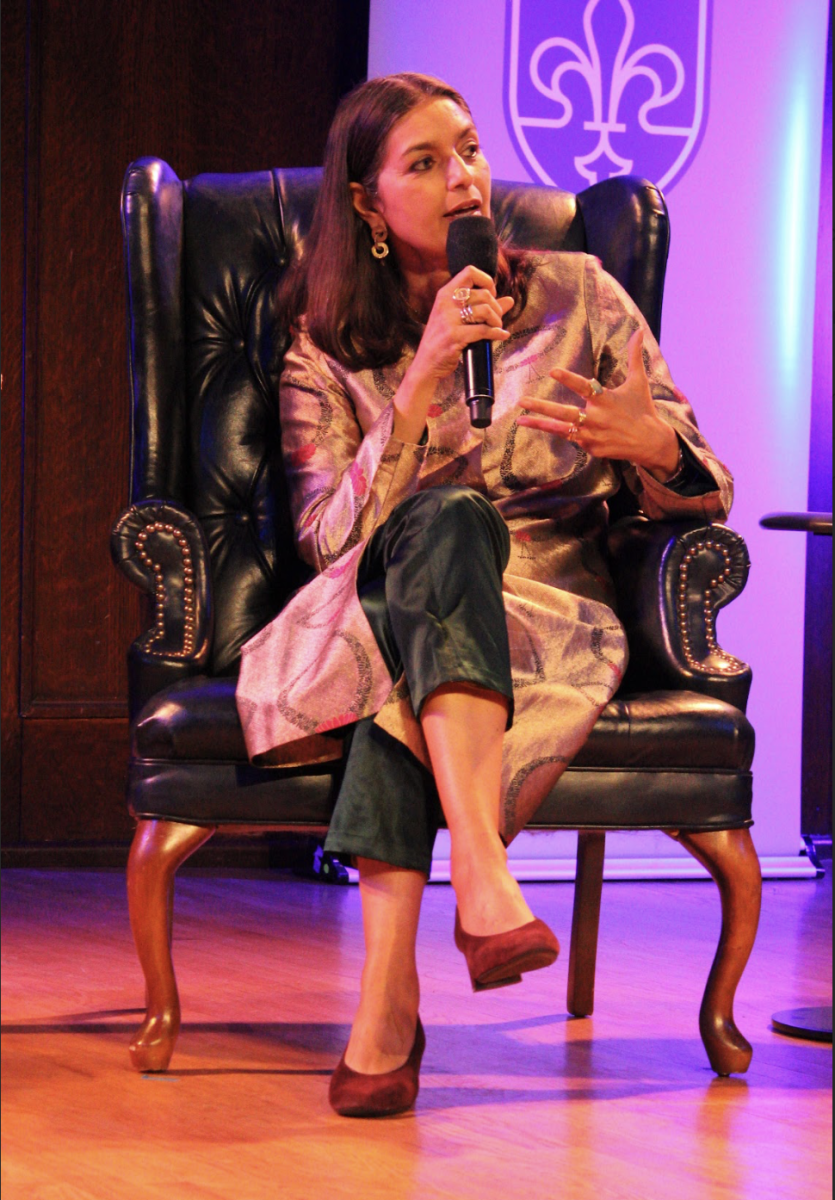
In a conversation with St. Louis Post-Dispatch columnist Aisha Sultan at the ceremony, Lahiri began with a discussion on the importance of exploring complex and underrepresented narratives.
“When I was writing the stories, there was no conversation,” Lahiri said. “I was sort of digging out of a place of silence and invisibility and no language, no vocabulary. And as we know, language is so important in order to be able to sort of legitimize experiences, right? Because without words, we aren’t able to explain or express basic things.”
Yet, Lahiri’s expereince exploring themes of identity and grappling with its meaning has led her to a unique perspective.
“I really have gotten to the point in my life where I don’t move toward identity at all,” Lahiri said. “I just live my life and I accept certain parts of me that I think I want to cultivate.”
Just as a lack of identity brings her peace, Lahiri said a unique understanding of belonging allows her to write as she does.
“I cling to my alienation,” Lahiri said. “I don’t want to belong. I don’t want to feel comfortable in any place. I can’t afford that, because if I do, I won’t be able to write my stories anymore.”
The award ceremony further included both a music and dance performance and a reading of the poem “Es Sang vor Langen Jahren,” translating to “It Sang Many Years Ago” by Clemens Brentano. Spoken in English, sung in German and telling a story of lost love, the poem represented both Lahiri’s work as an interpreter and her common themes of isolation and belonging.
In her craft talk with moderator Dr. Maryse Jayasuriya, Lahiri discussed the importance of learning other languages, revising creative works diligently and working in uncertainty. She said that life’s biggest questions are unsolvable, but that their exploration is imperative.
“Why are we mortal? Why is life hard? Why do people die? Why do things change?” Lahiri asked. “No writer can come and resolve those questions because these questions are part of who we are. We can’t live without facing and wrestling with these questions. So the writer has to kind of accept that.”
As part of the CLCA’s community engagement initiatives, some high school students enrolled in the 1818 dual credit program attended the craft talk. One student asked how to cope with feelings of unoriginality in an open Q&A portion.
“Maybe it’s overrated, this idea of being unique. I mean, I think artists are always responding to other artists and being in conversation with them,” Lahiri said. “I think each of us is profoundly unique. But also, we’re part of a fabric … and that’s what makes us and that’s what sustains us, is this fabric of other voices and other texts.”
Lahiri ended by teasing two recently finished projects: a translation of Ovid’s “Metamorphoses,” which she has been working on with a classicist for the last five years, and a new novel whose details were kept secret.
Executive Director of Literary Award Programs Ted Ibur said in his remarks at the award ceremony that Lahiri’s works further the long-standing mission of the program.
“What matters most is the profound way that her stories connect to us,” Ibur said. “At a moment when our public conversation sometimes feels very divided, literature remains one of the most powerful ways that we have to cultivate empathy and recognition. And that simple act of recognition may be one of the most important things that art can offer to society.”