


Watermelon Week kicked off at Saint Louis University on Monday, Oct. 6, as student organizations launched a weeklong fundraising campaign to support humanitarian relief efforts in Palestine through the Human Development Fund.
The Muslim Student Association partnered with the Pakistani Student Association, Middle Eastern Student Association, Caribbean-Latin American & Hispanic Student Association, Ethiopian-Eritrean Student Association and other campus groups to organize the initiative. The fundraiser aims to provide essential resources, including food packages, clean water, medical supplies and emergency shelter, to displaced families.
The HDF, which sponsored Muslim student associations nationwide to host Watermelon Week events, provides clear donation breakdowns: $7 buys a hot meal, $10 provides a hygiene kit, $55 supplies a family of five with a week’s worth of food, $150 purchases a 5,000-liter water tank and $900 funds a furnished tent for displaced families.
Monday’s kickoff event, Keffiyeh Day, encouraged students to wear the traditional Palestinian scarf to show solidarity. The keffiyeh, a black-and-white patterned cloth, symbolizes Palestinian heritage and resistance. At the tabling event in the Busch Student Center, organizers displayed informational materials explaining the scarf’s design: the fishnet pattern represents a connection to the sea, olive leaves signify the cultural and economic importance of olives, and bold lines trace historical trade routes.
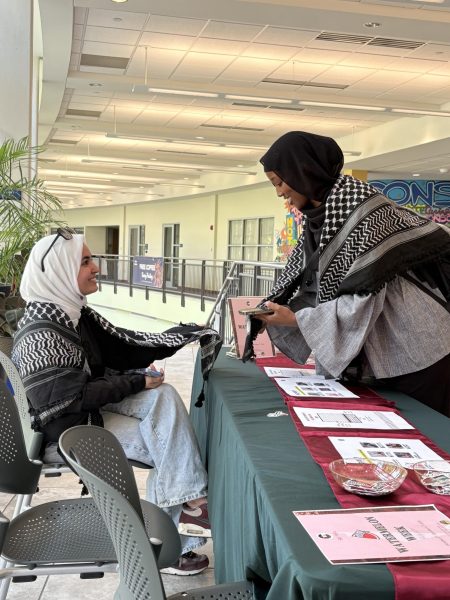
MSA members sold pro-Palestine stickers for $1 donations and accepted additional contributions through a QR code linked to the HDF fundraising page.
“We want to help people,” said Nora El-Ruwie, vice president of external affairs for MSA and junior studying computer science. “There are people out there who are suffering and don’t have the luxury that we have every day, and it’s really important to do everything that we can to help them.”
El-Ruwie said MSA first participated in Watermelon Week in 2024, when the event was still small. This year’s fundraiser, she added, involved greater planning and collaboration among student groups.
Hanzalah Ahmed, public relations chair for MSA and a junior studying health management, said the group sees activism as part of its responsibility on campus.
“I think it doesn’t matter how much you raise … you should do whatever you can,” Ahmed said. “At the end of the day, even a dollar will help them.”
Students visiting the table echoed that sentiment. Amyra James, a freshman studying medical sciences, said advocacy remains important even without financial means.
“If you don’t do your part to support the cause and spread awareness, then what are you doing out there?” James said. “Even if you’re not coming from a place of overwhelming resources, you can still do the most that you can do … If you were in the same position, you’d want people to advocate for you too.”
Merjema Klincevic, a sophomore studying economics, said showing solidarity on campus helps humanize ongoing struggles abroad.
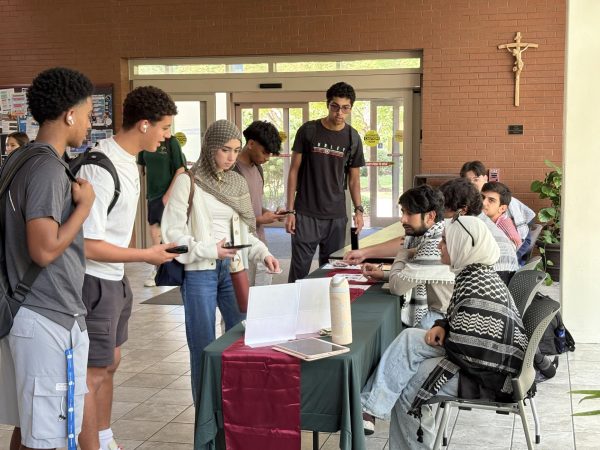
“It’s important to acknowledge the struggle of Palestinian people and to really show our support,” Klincevic said. “Especially as college students … show that we believe these people are human and deserve every single human right.”
Fatima Amjed, president of PSA and a sophomore studying neuroscience and psychology, said the initiative connects humanitarian action with cultural education.
“There’s a really bad genocide going on in Palestine,” Amjed said. “It makes me so happy [to see students wearing the keffiyeh], because it raises awareness and helps educate others about what it means.”
Throughout the week, MSA and partner organizations hosted additional events, including a watermelon-eating contest on Wednesday, Oct. 8, at the clock tower and a presentation on advocacy for Palestine. El-Ruwie said the creative events were designed to engage students while keeping the focus on fundraising.
As of Saturday, Oct. 11, the final day of Watermelon Week, SLU’s MSA raised more than $2,000 — double its original goal.


